Anatomical poster of the spine
Human anatomy is often illustrated by the skeleton, as seen on the anatomical skeleton chart, and thus by the spine, shown on the various anatomical skeleton charts. The spine, or "rachis," is composed of:
Which you will find on the various En Chair et en Os anatomical charts.
At the thorax level, the spine is accompanied by the costal cage, 12 pairs of ribs, attached at the front to the sternum by sterno-costal cartilages; they are all visible on the psoas-iliac anatomical chart.
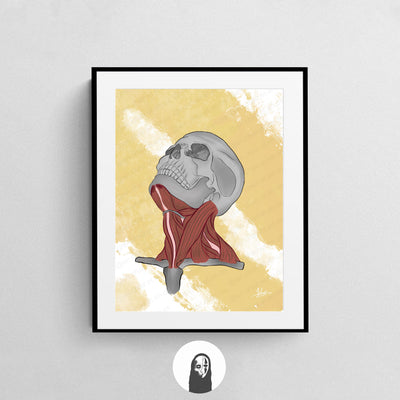
The skull is a group of body bones that are regularly seen in medical offices, osteopathy offices, or physiotherapy clinics. It is composed of paired and unpaired bones: the frontal, parietal, temporal, occipital, maxillary, mandible... which can be found on the anatomical chart of skull bones.
Inside the skull are the structures present on the anatomical chart of the reciprocal tension membranes, with the falx cerebri, the tentorium cerebelli, the pituitary gland, and the falx cerebelli, as depicted on the anatomical chart of the cranial diaphragm, which is part of an osteopathic concept.
Depending on the setting, the need to show a model of the anatomy of the shoulder skeleton, arm, elbow, or hand may be necessary, such as for students in medicine, manual therapy, but also art.
The upper limb includes the shoulder area, with the scapula, clavicle, and humerus. The shoulder has 5 joints: 3 "true" and 2 "false" ones.
The elbow articulates further down with the radius and the ulna to form the elbow. The ulna and radius articulate further down with the carpal bones to form the model of the hand with the metacarpals and phalanges.
The anatomical chart of arm muscles summarizes all the muscles of the arm.
The study of human and medical sciences also shows us the importance of learning human anatomy, which includes the lower limb. This includes the hip, formed by the coxal bone and the femur, providing the coxofemoral joint. The femur articulates further down with the tibia, fibula, and patella to form the knee, the femorotibial and superior tibiofibular joints.
Further down, the tibia and fibula articulate with the talus to form the ankle. The foot is composed of tarsal bones, ankle bones, and phalanges.
The anatomy of the leg is shown on the various anatomical charts of leg muscles and the anatomical charts of the leg skeleton.
The leg model includes various groups of muscles, as depicted on the anatomical chart of leg muscles from En Chair et en Os, connecting the hip to the knee. The main groups are:
-
The quadriceps, located at the front of the leg surrounded by the sartorius, with:
-
The rectus femoris
-
The vastus lateralis
-
The vastus medialis
-
The vastus intermedius
-
The hamstrings at the back of the leg, with:
-
The biceps femoris
-
The semimembranosus
-
The semitendinosus
-
The adductors, inside the thigh, with:
-
The adductor brevis
-
The adductor longus
-
The adductor magnus
The gracilis and pectineus accompany the adductors.
All these muscles are uniarticular or polyarticular and allow for flexion, extension, adduction, or abduction movements of the leg under the thigh and hip.
Other muscle groups span from the leg to the foot and are represented on the various anatomical charts from En Chair et en Os.
The arm includes various muscle groups, all represented on the anatomical chart of arm muscles.
On a human model, what stands out most often on an arm is the biceps and triceps brachii. However, all muscles play their role in the proper physiology of the arm. Hence the importance of the functionality of the rotator cuff, composed of:
Anatomical poster of abdominal muscles
All are represented on the anatomical chart of trunk muscle chains made by En Chair et en Os.
Anatomical chart of foot muscles
The foot is represented on the foot charts, hand-drawn by En Chair et en Os.
Anatomical chart of the perineum
The anatomical representation of the perineum shows its importance in both women and men, particularly regarding variations in intra-abdominal pressure, as well as quality of life (sexuality, bowel movements, urination...).
It can be synthesized as the pelvic diaphragm, though this does not include all the muscles of the perineum.
Anatomical chart of the nervous and vascular system
Anatomical poster of the brain
The brain is often represented in human sciences; it provides beautiful decoration for various medical, psychotherapy, psychiatry, chiropractic, and osteopathy offices.
Anatomical chart of nerves
Nerves are the source of movement and the transmission of nervous information. They can be represented by the central nervous system (brain + spinal cord) but also by the autonomic nervous system.
Anatomical representation via a chart of the nervous system is recurrent in order to provide a clear visual of their endings and actions, such as on the anatomical chart of Rodin's The Thinker.
The autonomic nervous system can also be depicted with its various ganglia and relationships to viscera and organs.
Anatomical chart of organs
Anatomical poster of the heart
The heart is a key element, especially when discussing pathology. The heart is the source of the proper functioning of the entire organism, as it circulates blood permanently and regularly throughout the body. It can be a beautiful element of anatomical decoration in an office.
Anatomical chart of the lungs
The lungs are key to the oxygenation of the human body and part of the respiratory system; accompanied by other elements, they can be a beautiful decoration of the respiratory system.
Anatomical poster of the digestive system
The digestive tract, by En Chair et en Os, is the key to digestion and thus the absorption of elements essential for the proper functioning of the human body. It draws its energy from food: lipids, carbohydrates, and proteins.
Anatomical chart of the genitourinary system
The kidneys, ureters, bladder, and urethra allow for showing the entire system that can be affected by pathology.