
Author: Naël El Kastani
In every medical practice, anatomical charts play a key role.
Why? Because they allow for an understanding of the components of the human body in a visual and clear manner. Whether you are a specialist in surgery, general medicine, or even in paramedical fields, the use of these materials, available on our site En Chair et En Os, is essential for patient diagnosis and care. The goal is to make anatomy accessible and to facilitate communication with your patients.
Understanding human anatomy: an essential foundation for every procedure
Anatomical charts: a means of precisely locating the structures of the human body
The first step in a reliable diagnosis consists of precisely locating anatomical elements. Indeed, every part of the body, whether it concerns the skeletal system, muscles, internal organs, or the nervous system, plays a specific role. It is therefore essential to master the exact location of each element in order to be able to identify a dysfunction.

A Human Skeleton Chart is an excellent example of a tool that allows for the visualization of the anatomy of the main bones of the human body. Let us take the case of a patient presenting with lower back pain: a simple glance at a poster detailing the spinal column, the vertebrae, and the sacrum immediately makes it possible to understand where the pain is located. Such a chart is of great help, not only for locating the source of the pain but also for creating an adapted treatment plan, whether it is based on muscular rehabilitation or more targeted care.
This leads us to the following question: how can we ensure that our diagnoses and treatments are well-targeted? 🤔 The answer is simple: by using reliable posters that allow us to better define the anatomy and functions of the body.
Understanding the systems of the human body through drawings
Posters are not limited to skeletal organization alone. They play a key role in grasping the complex interactions between the different systems of the body. In this case, by combining a Human Musculature Chart with an illustration of the nervous system, a healthcare professional can better analyze dysfunctions that affect both muscles and nerves.

Take the example of a patient suffering from radiating pain in the upper arm following an injury to the radial nerve: a nervous system poster allows for the precise localization of the affected area and the visualization of the relationship between the nerves and the muscles. In this way, the practitioner can use this information to intervene in a more targeted manner, by choosing a therapeutic approach that could involve muscular rehabilitation techniques or treatments to soothe nerve tension.
Posters are therefore a true reference for connecting the different parts of the organism and grasping how they work together. They are essential for understanding the role of organs, muscles, and nerves in various pathologies. 💡
Using charts for clear communication with the patient
Drawings as a pedagogical tool
As healthcare professionals, we know how difficult it can be to communicate clearly and understandably with our patients, especially when it comes to complex concepts like human mechanisms. Charts are tools that allow for the visualization of internal elements, the highlighting of components, and the simplification of explanations.
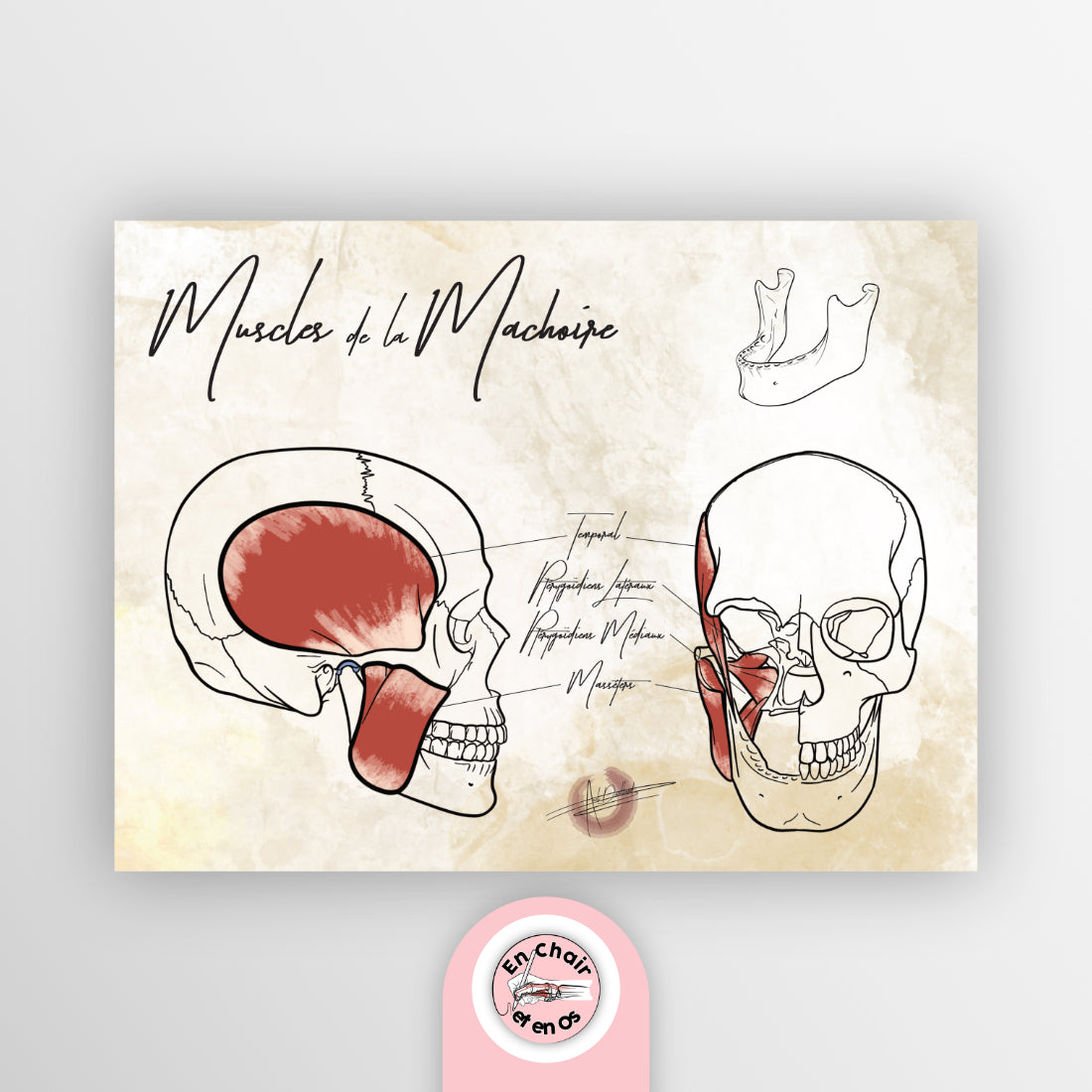
Take the example of a patient who consults for jaw pain. A Jaw Muscles Chart can illustrate the location of the masseter muscle and the temporomandibular joint. By showing this image, the practitioner can easily explain the origin of the pain (notably linked to muscle tension due to bruxism) and thus involve the patient in understanding their condition. This process of visual explanation also allows the patient to better perceive the importance of the proposed treatment and strengthens their adherence.
Illustrations are powerful didactic aids that make it possible to explain complex concepts with total simplicity, while facilitating the patient-practitioner relationship. 😊
Creating a bond with the patient through illustration
When the patient visualizes a drawing that corresponds to their own condition, they often feel more reassured and involved. The image acts as a bridge between the practitioner's knowledge and the patient's perception, helping them better grasp what is happening inside them. This is particularly true in the context of pathologies that affect internal systems, such as the digestive system.

Imagine a patient suffering from abdominal pain. By showing a Stomach Chart, a gastroenterologist can explain in detail the possible origin of the pain (notably gastritis or an ulcer). This allows the patient to grasp not only the location of the pain but also the function of the organ concerned. Using illustrations in this context makes the situation more tangible and understandable, while reinforcing the patient's confidence in their medical follow-up.
Optimizing treatments using anatomical charts
Charts as a guide in care planning
In a healthcare environment, one of the main objectives of posters is to guide the practitioner in planning treatments, whether it involves muscular rehabilitation or surgical interventions. Take the case of a patient requiring surgical intervention on the trunk or spinal column. A drawing detailing the bone and muscle anatomy of the trunk is an indispensable tool for locating the areas to be treated. It serves as a reference for guiding surgical movements and avoiding errors in the operating room.

Also imagine a case of cardiac surgery: a Heart Chart allows one to identify and precisely define where the different tissues are located, thus ensuring the success of the intervention.
Posters are therefore precious tools for optimizing the precision of care, particularly when it comes to treating complex pathologies or preparing for invasive interventions. 🩺
Charts as a tool for post-therapeutic follow-up
After treatment, monitoring the patient's progress is a crucial step in ensuring optimal recovery. Posters play an essential role in this phase by facilitating the understanding of progress made and clarifying the steps ahead. Take the example of a patient who has undergone hip surgery: the use of a Lower Limb Muscle Chains Chart can be extremely beneficial. This drawing makes it possible to visualize the operated area precisely, locate the prosthesis, and explain the rehabilitation steps necessary to recover mobility.
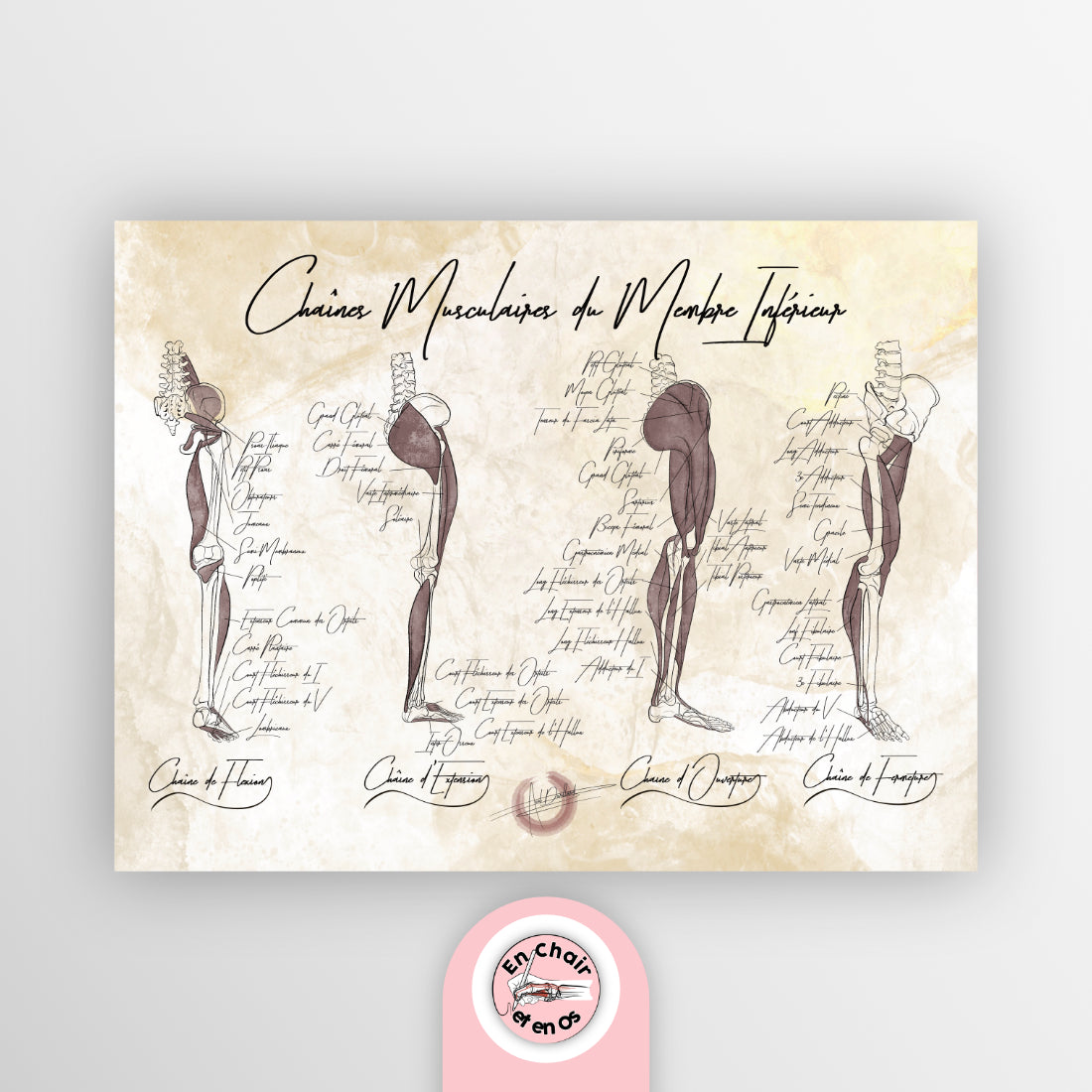
By showing the patient a visual representation of the anatomy of the lower limb, we can better ensure their understanding of the healing process. It also offers a clear perspective on the evolution of their condition, which can be extremely reassuring. Furthermore, it fosters a sense of active participation in their own recovery, by allowing them to track their progress and remain motivated on their rehabilitation journey. 💪
Conclusion: The critical importance of anatomical charts
These charts are not mere illustrations. They are essential tools that play a fundamental role in several aspects of medical practice:
-
Understanding human structure
-
Communicating more effectively with patients
-
Optimizing treatments by offering a clear and detailed view of pathologies and structures.
Whether for locating structures, explaining a complex pathology, or planning a surgical intervention, these drawings provide a precise overview of the organism. They facilitate decision-making and action with great efficiency and safety.
But why integrate them into every consultation? 🤔 Because their presence enriches the exchange between the practitioner and the patient, thus transforming every interaction into a moment of education and understanding. By visually showing the areas involved, these illustrations help to reassure the patient, clearly explain the proposed treatments, and strengthen confidence in the therapeutic process.