Author: Naël El Kastani
Learning human anatomy is a challenge for many, whether they are medical students, artists, therapists, or even patients themselves. Between complex terms, invisible structures, and multiple layers, understanding how the human body works can quickly become a labyrinth. Yet, one method has proven effective for centuries: drawing.
Much more than an artistic technique, drawing anatomy means learning through observation, reproducing to better memorize, and deconstructing to reconstruct knowledge.
Drawing as a tool for sensory learning of anatomy
Learning with your hands to learn with your brain
Anatomy is sometimes perceived as a static set of structures to memorize. However, as soon as you start drawing the human body, a shift occurs: understanding becomes active. You no longer just read an anatomy book; you live it, line by line, pose by pose.
Take, for example, the Anatomical Chart - Skull Bones: this illustration highlights facial proportions, the bone structure of the head, and the complex yet logical organization of the different parts of the skull. On this anatomical page, every drawn detail is an invitation to understand the form, the volume, and above all, the function of each anatomical element.

Why this chart? Because it perfectly illustrates the power of classical anatomical drawing: you don't just know the names of the bones, you learn to visualize them, retrieve them mentally, and place them in space.
By reproducing these diagrams, the learner establishes their reference points and structures their knowledge. This forms a solid foundation for explaining to a patient why, for instance, jaw pain might be linked to tension in the temporomandibular joint.
The line that guides thought: the importance of the gesture
In the practice of drawing, every line becomes meaningful. Drawing forces you to ask the right questions:
Where does this muscle begin? Where does it attach? What is its exact shape?
This approach helps avoid the trap of superficial memorization. Drawing anatomy is about questioning the logic of bodily structure. It is also about training oneself to observe the actions of the upper body, the head, the foot, the upper or lower limbs with a more precise eye.
Books today offer various formats, from paperback books to accessible digital drawings, to allow for this immersion in detail. Sketching exercises become moments of deep integration.
From drawing to understanding body function
Understanding body mechanics through drawing
Drawing the human body is not just about reproducing its external form. It is about grasping internal interactions, particularly those between organs and systems. A telling example: the Anatomical Chart - Stomach.
This anatomy drawing presents the stomach in its context: its relationships with the liver, the diaphragm, and the pancreas. It allows one to visualize the complexity of the area and better learn the physiology of this organ.

This chart is essential for healthcare professionals explaining the effects of stress on digestion to their patients, or the mechanisms of certain gastric pathologies. It offers a simple yet complete visual aid that helps create a clear mental representation. The stomach is no longer just a word; it is a drawn form, anchored in an anatomical reality.
A pedagogy of the body through image
Drawing then becomes pedagogy. It structures the practitioner's discourse, who can rely on illustrations to educate, reassure, and offer more comprehensive support.
Patients are often lost when faced with medical terms. A well-chosen anatomy drawing becomes a bridge between the caregiver's knowledge and the patient's understanding. Far from being a mere tool for artists, it becomes a guide for medical communication.
Anatomical drawing to link structure and movement
Artistic anatomy at the service of movement
Anatomy does not stop at form. It lives in dynamic action. Understanding with the Anatomical Chart - Muscle chains of the neck means integrating a functional vision of the human body.

This chart is particularly useful for physiotherapists or osteopaths. It allows for visualizing how tension in the scapula elevators can lead to postural imbalances, upper back pain, or even headaches.
It perfectly illustrates the importance of drawing characters in activity to integrate human visualization through drawing.
From static sketch to dynamic movement
Anatomy drawing is not limited to frozen poses. The exercises offered in some books for artists often include movement sequences or dynamic models.
A good case is the Anatomical Chart - Badminton. One might think it is a curiosity, but it offers a concrete case of anatomy in action.
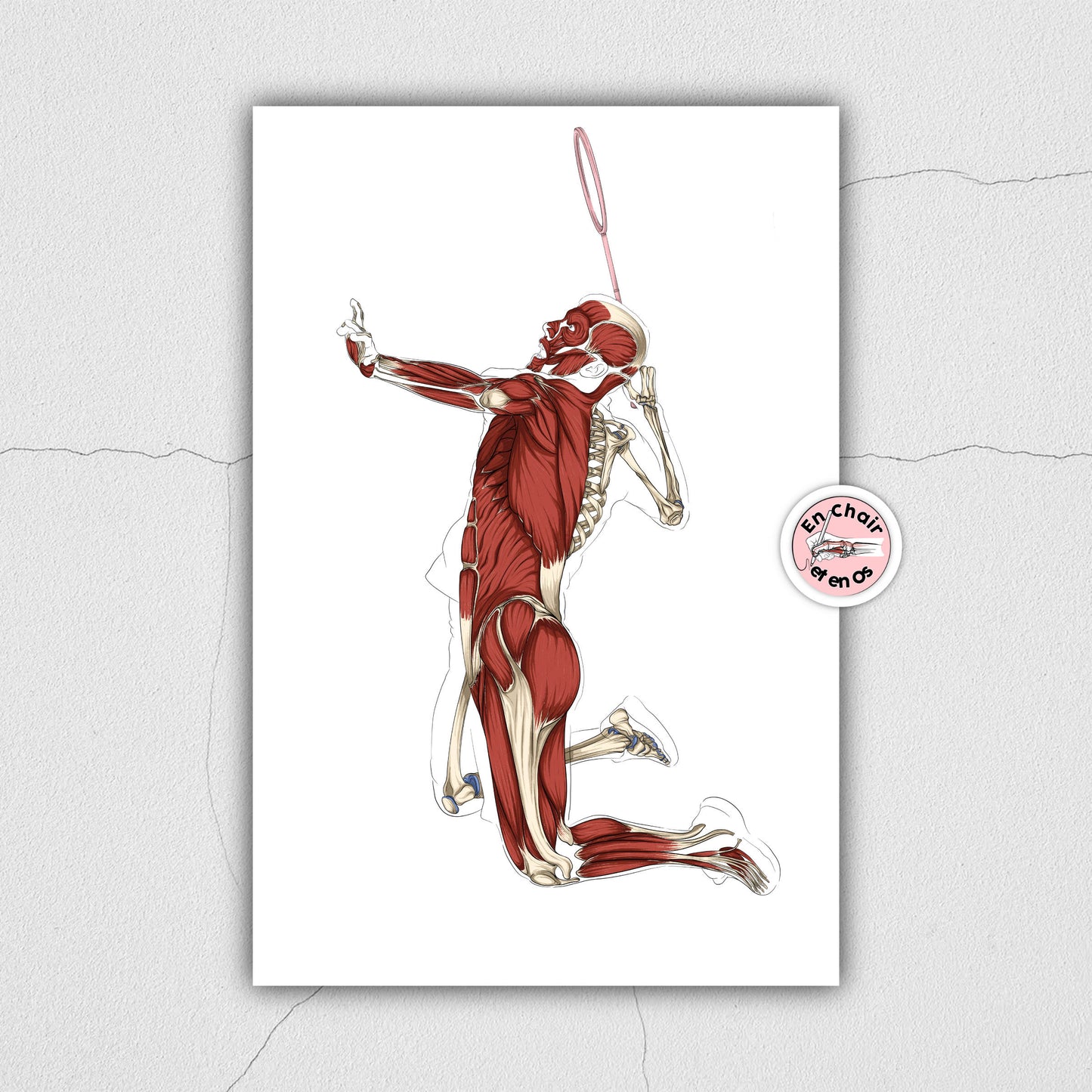
This drawing highlights the upper limbs, the spine, and the foot in full activity. It helps illustrate the fine coordination of anatomical elements, muscle contraction, and joint angles under strain. It is a living model, useful both for anatomy students and for athletic patients seeking to perceive the origin of an injury.
Drawing as a bridge between artistic practice and medical rigor
Anatomy and drawing: two compatible languages
There is a common culture between the artist and the healthcare practitioner: that of observing bodily structure. Artistic anatomy books allow us to approach the body not only as an object to be treated but also as a living, complex, and aesthetic system.
A good example is the Anatomical Chart - Rib elevators.

It shows deep muscles, rarely mentioned, but essential in breathing, posture, and even certain chronic back pains.
Reading this anatomical page offers a detailed view of these small muscles, which one might tend to forget. It highlights the importance of drawing anatomy with precision so as not to neglect what seems insignificant.
Educating patients through images
Educating patients on the anatomy of the torso, lower limb, or hand does not necessarily mean bombarding them with diagrams. It can be done through simple sketches, illustrated explanations, and digital drawings that you offer them to consult between sessions.
The Anatomical Chart - Occipito-thyro-thymo-pericardial fascia is, in this respect, a rare and precious model.

It allows for connecting anatomical structures together, from the base of the skull to the mediastinum. This chart is a true anatomical narrative tool to show bodily unity through continuous lines, fluid volumes, and cross-functional roles.
Conclusion
Anatomical drawing is much more than an art; it is a powerful pedagogical technique, a communication tool, and a gateway toward understanding how the human body functions.
Whether it involves drawing characters, reproducing models, or simply visualizing key elements of human anatomy, drawing—available on our site En Chair et en Os—fosters deep and lasting understanding. It complements the anatomy book, enriches the explanatory video, and offers healthcare professionals an effective and human way to transmit their knowledge.
By combining scientific rigor and the aesthetics of the line, anatomy and art become one. And that is undoubtedly where the strength of drawing in learning human anatomy lies.