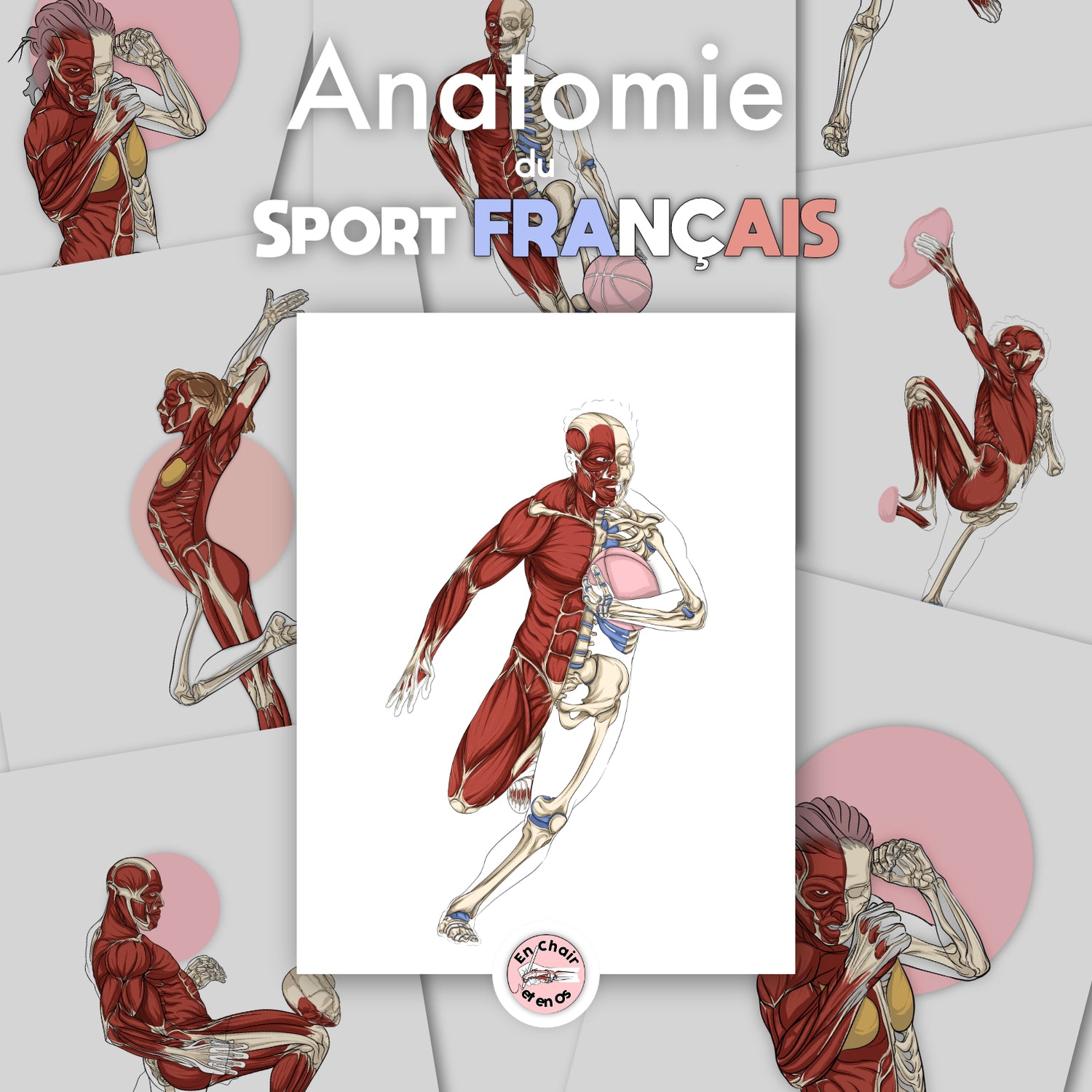
The anatomy and movement pedagogy offered by Petit Pilates required custom illustrations adapted for children's understanding. And that is not something you can find on Google Images.
That is why Petit Pilates, the leading Pilates method for children in France, contacted En Chair et en Os. The project: to create a complete series of personalized anatomical illustrations to support their teaching.
In total, 13 illustrations of the human skeleton and muscular system were hand-drawn. From the skull to the hamstrings, each anatomical structure was designed to be understood by a child, while remaining scientifically accurate.
This article recounts that collaboration. And if you are a healthcare professional with a similar need, it also gives you a concrete idea of what a custom anatomical illustration commission entails.
Petit Pilates: learning human anatomy while moving
Petit Pilates is a project created in 2018 by Florence Coirier Giraudon and Marion Commarmond, both Pilates instructors. Marion is also a former professional dancer with a state diploma.
The idea behind it is simple: children understand their bodies better when they make them move.
The problem is that when it comes to teaching how the human body works to children, the anatomical charts found on the market don't work. Anatomy textbooks are made for health students. There is too much detail, not enough readability, and no adaptation for the audience.
Petit Pilates needed visuals that show parts of the human body in a precise but accessible way. Illustrations where an 8-year-old child can point to a bone, a joint, or a muscle, and understand what it does when they move.
That is where En Chair et en Os stepped into the project.

13 hand-drawn anatomical charts
The commission covered the major anatomical regions of the human skeleton and the muscular system. Here is what was drawn:
The skeleton, bones, and bony structures:
The pelvis, feet, skull, rib cage, spine, bones of the lower limb, occiput, sacrum, scapulae (shoulder blades), and bones of the upper limb.
The muscular system:
The quadriceps, hamstrings, and abdominal belt—two central muscle groups for understanding movement, posture, and muscle contraction.
Each chart was drawn by hand. No image banks. No recycled diagrams. An original drawing for each structure of the human body, designed for the needs of Petit Pilates.
[Photos of the charts created for Petit Pilates to be inserted here]
What changes when an illustration is custom-made
When a professional (physiotherapist, osteopath, midwife, surgeon, trainer) uses an anatomical visual daily, they need that visual to serve their work, not complicate it.
The problem with a generic diagram is that it shows too much or too little. It is not adapted to your specialty. It does not fit your visual identity. And above all, it does not say what you want to convey to your patients or students. We discuss this in more detail in this article on the role of anatomical charts in therapeutic education.
A custom illustration solves all of that.
For Petit Pilates, that meant charts where the axial skeleton (skull, rib cage, spine, sacrum) and the appendicular skeleton (upper and lower limbs, scapula, pelvis) were represented with a level of detail adapted for children, without sacrificing anatomical rigor.
For a physiotherapy clinic, it might be a chart centered on the lower limb that highlights the structures involved in a specific pathology. If that resonates with you, take a look at how an anatomy poster influences patients in a physiotherapy office. For an osteopath, a view of the occiput and sacrum showing craniosacral dynamics. For a surgeon, an intraoperative drawing of a specific surgical approach.
In any case, the illustration serves your practice. Not the other way around.
How a custom anatomical illustration commission works
Each project follows a simple process:
1. Discussing the need What will the visual be used for? Teaching human anatomy to students? Explaining a pathology to a patient? Decorating an office with a visual that reflects your specialty? Everything starts with a discussion.
2. Anatomical research Each illustration is based on precise references: reference manuals, descriptive anatomy atlases, and human physiology. For the Petit Pilates charts, the work focused on the bones, joints, and muscle groups involved in human body movement.
3. Hand-drawing This is what makes the difference. Every line is traced by hand. This allows for total control over the readability, aesthetics, and precision of every anatomical structure, from the most superficial muscle tissue to the deepest connective tissue.
4. Adaptation to the medium and audience A poster for a medical office does not have the same constraints as educational material for children or an illustration for a scientific publication. The format, level of detail, and graphic style are adapted to each project.
5. Delivery and printing Files are delivered in high definition, ready to print. For En Chair et en Os posters, printing is carried out in France on quality, Imprim'Vert-certified paper.
Who are custom illustrations for?
If you are a healthcare professional (physiotherapist, osteopath, sports doctor, podiatrist, midwife) and you are looking for an anatomical visual that truly corresponds to your practice, custom creation is for you.
In practice, the most common requests involve:
Surgical illustrations for medical publications or presentations. Educational materials for training in anatomy, physiology, or biomechanics. Large-format anatomical wall murals to transform an office or waiting area. Specific anatomical charts centered on a region of the human body (head and neck, thorax, abdomen, pelvis, upper limb, lower limb) or on a particular system (muscular, skeletal, nervous).
And sometimes, as with Petit Pilates, projects that go beyond the classic framework. Projects where anatomy meets a pedagogical, sporting, or artistic universe that is a little different. Much like our anatomical drawings of athletes, which cross athletic performance with anatomical rigor.
Why anatomical precision is non-negotiable
In the health field, an approximate anatomical visual isn't just a bad drawing. It is a real pedagogical problem.
A physiotherapy student who learns human physiology from an imprecise diagram will internalize poor representations. A patient who is shown an overly simplified drawing does not truly understand their pathology. And a professional who displays an anatomical chart in their office sends a message about their standards of excellence. This is something we explore in this article on the influence of anatomy posters in osteopathy offices.
That is why every En Chair et en Os illustration, whether it is a poster from the catalog or a custom commission, is verified, cross-referenced with current anatomical sources, and drawn with the same care.
The collaboration with Petit Pilates is a good example: 13 charts covering the human skeleton and the main muscle groups, each drawn with precision adapted to a young audience without compromising on anatomical accuracy.
Do you have an anatomical illustration project?
Whether it is for educational material, a wall mural, a scientific publication, or a project you haven't seen anywhere else, every collaboration begins with a conversation.
Describe your need (anatomical region, medium, target audience, context of use) and we will provide you with a tailored proposal. Every project is unique. So is every illustration.
→ Contact us to discuss your custom project
In the meantime, you can also discover our anatomical charts of the human body already available, or browse our articles on anatomy posters and their use in clinical practice.
En Chair et en Os designs original anatomical illustrations, hand-drawn and printed in France. Educational posters, wall murals, surgical illustrations, and custom creations for professionals who demand precision.