

How to create an anatomical flayed figure from a photo?
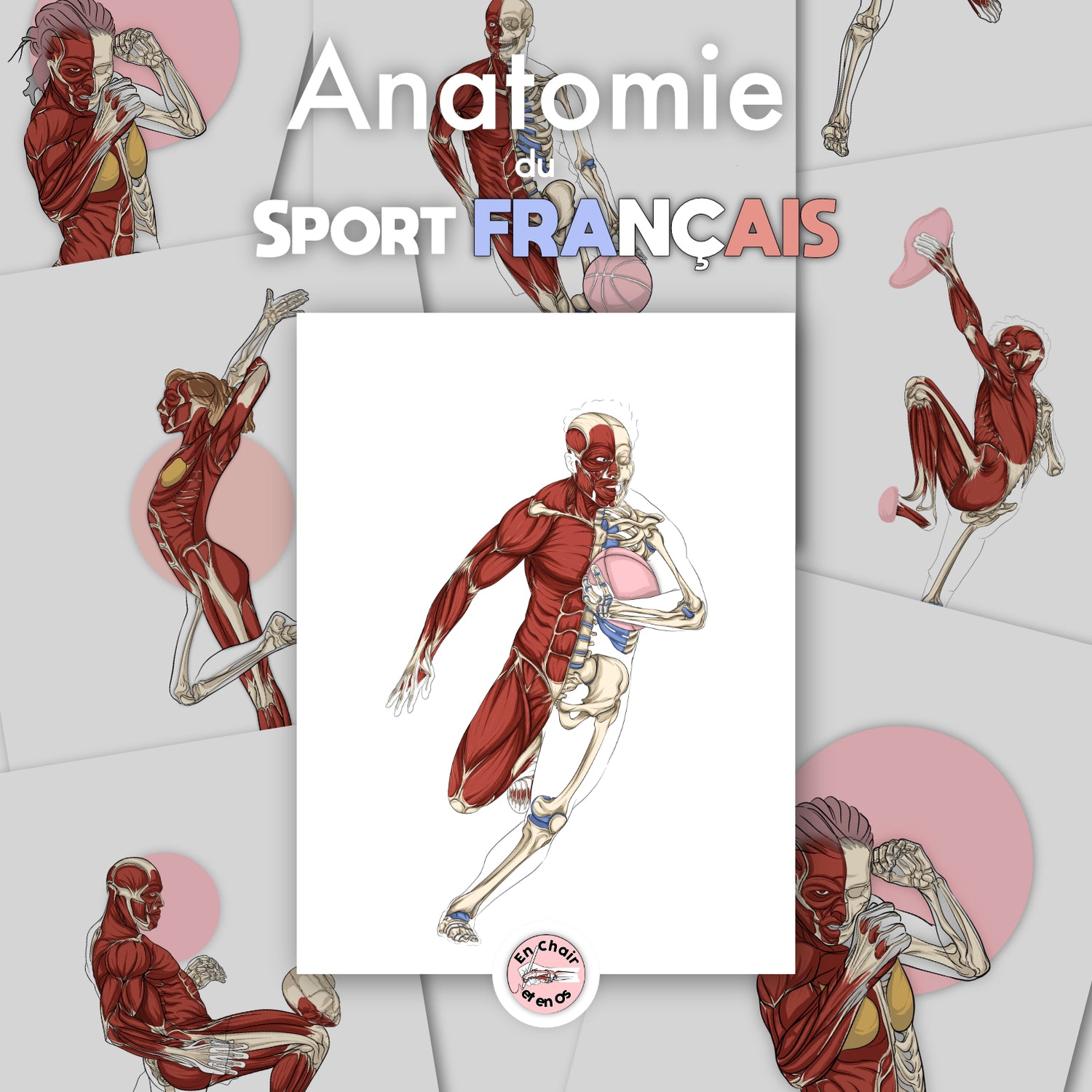
In this article, I will show you the method I use to create an anatomical flayed figure from a photo. We will take as an example the creation of the anatomical football flayed figure, created from a photo of Zinédine Zidane.
One of the first obstacles when starting this type of drawing is that the anatomy learned in books is often presented in a standard anatomical position, static and perfectly aligned. However, the human body does not function like a diagram.
Creating a flayed figure from a photo is an excellent exercise to verify if you have truly understood anatomy: you must succeed in replacing what you cannot see (bone and muscle structures) beneath the skin, taking into account movements, torsions, and individual variations.
Out of curiosity, or to do it yourself at home, here are the steps to follow to create the anatomical football flayed figure from a photo of Zidane.
Step 1: Construct the geometric shapes

You have to start the draft somewhere. The body varies from one individual to another, but certain areas can be synthesized into simple geometric volumes. For example, the rib cage can be represented by an egg cut at its upper end.
This step is fundamental: the geometric shapes will serve as a base to then place all the bone and muscle structures. If the rib cage or pelvis are poorly positioned at this stage, everything will be distorted.
Step 2: Lay down the bone structure, the most difficult step

We continue the draft with bones. From these base volumes, I build the skeleton. In my opinion, this is the most complex step.
The pelvis, in particular, is difficult to visualize in 3D, especially on a body in motion. As for the rib cage, it is composed of numerous ribs, which move according to the inclination or rotation of the trunk, making them even more complicated to diagram.
Under these conditions, one cannot simply trace a classic anatomical diagram. You must rely on the palpable landmarks you know that are more or less visible in the photo to best adjust the position of the bones.
For example, I know that this structure is located here because when I press on my shoulder, I feel a bone, so I will place the acromioclavicular region roughly in this area.
Step 3: Represent muscle anatomy, the skeleton comes to life

The draft starts to take shape thanks to the muscles. Once the skeleton is in place, I move on to the muscular system. This is the most enjoyable step for me, but also the one that requires the most observation.
You must ask yourself the following question: "Which muscle can cause this relief visible in the photo?" And to answer it, you draw on your knowledge: origin, insertion, path.
When using a model as a reference who is not a bodybuilder, and therefore not lean and defined muscularly, you must be able to hypothesize and get as close to reality as possible regarding where the different muscles and tendons are located. However, some areas are always complex, such as the forearm in pronation-supination, or the overlap between the serratus anterior and the external oblique on the rib cage.
Step 4: Refining

At this stage, we have a complete draft with bone and muscle structures. Now we must refine the contours, simplify where necessary, correct proportions, and make everything readable. This refining step is essential for the flayed figure to be understandable and visually coherent.
Step 5: Adding color

Last step: add color, shadows, and contrast. This is where the flayed figure comes to life. One can choose to remain very academic or, on the contrary, create something more artistic.
It is also the step where you decide the final degree of detail.
The anatomical football flayed figure can now be hung on your walls!
Creating a flayed figure from a photo requires moving away from static representations to enter the logic of the body in motion. It is a demanding exercise, but highly formative for refining one's understanding of anatomy.
If you wish to discover the final result of the Zidane flayed figure, or purchase a printed copy, you can find it below.